reactifact vs. LangGraph / CrewAI / plain function calls
This page is a comparison, not a pitch. reactifact is pre-1.0 (0.5.0), the
ecosystem is one maintainer, and there is no hosted platform, no managed
tracing SaaS, no marketplace of pre-built agents. If any of those are what you
need today, the honest answer is: use LangGraph or CrewAI, they're mature and
well-supported. Read on if the comparison below still tips your way.
TL;DR
| LangGraph | CrewAI | reactifact | |
|---|---|---|---|
| Primary abstraction | explicit state graph (nodes + edges) | role-based crew of agents | typed artifacts + reactive agents |
| Control flow | you draw it | mostly fixed (sequential/hierarchical) | derived from state changes |
| State | a shared, loosely-typed dict/TypedDict |
task outputs passed along | versioned, typed, immutable-per-version artifacts |
| "Why did it say that?" | requires manual logging/checkpoint inspection | not tracked by default | provenance graph (supported_by/derived_from/…) built in |
| Numbers/calculations | the LLM computes unless you write a tool | same | recipes push calculation into deterministic code, not the model |
| Rollback / branching | checkpointer + manual replay logic | not built in | context.branch(), three-way merge(), deterministic replay |
| Maturity / ecosystem | high — used in production widely | high — large community | pre-1.0, one maintainer, small examples set |
| Managed hosting | LangGraph Platform | CrewAI Enterprise | none |
| MCP | via LangChain adapters | via CrewAI adapters | client + server built in (reactifact.mcp, mcp extra) |
Where reactifact is not the right choice
Being upfront about this matters more than the feature table:
- You have a genuinely fixed pipeline. If the steps are always A → B → C with no branching by data, a graph framework (or a plain function) is less ceremony than modeling artifacts and consumes/produces.
- You need a managed platform today — hosted execution, a UI for non-engineers, an enterprise support contract. reactifact is a library; there is no SaaS behind it.
- You need a large pre-built agent/tool ecosystem. LangGraph and CrewAI
both have more third-party integrations, more Stack Overflow answers, more
production war stories. reactifact's
Sourceabstraction is intentionally small (filesystem, CSV, embeddings, web) — you write the rest.reactifact.mcp(docs) reaches any MCP server as aTool, which narrows this for tool-calling specifically, but doesn't touchSource/retrieval integrations. - Your team already has deep LangGraph investment. Rewriting a working system for architectural purity is rarely worth it. reactifact is a better fit for a new agent, not necessarily a migration target for an old one.
Where the difference actually matters
1. The state model: a dict vs. typed, versioned artifacts
LangGraph's state is a shared dict (or TypedDict) that every node can read
and mutate. That's flexible, but it means "what shape does the state have
right now" is a runtime fact, not something the type checker can verify, and
"who last touched this field" is not tracked unless you add it yourself.
reactifact artifacts are pydantic models. Every artifact has a type, an id, a
version, and a created_at. Nothing is deleted-and-overwritten in place — an
Update produces a new version, so context.diff(v1, v2) is a real,
inspectable operation, not something you have to reconstruct from logs.
2. Control flow: drawn graph vs. reactive dispatch
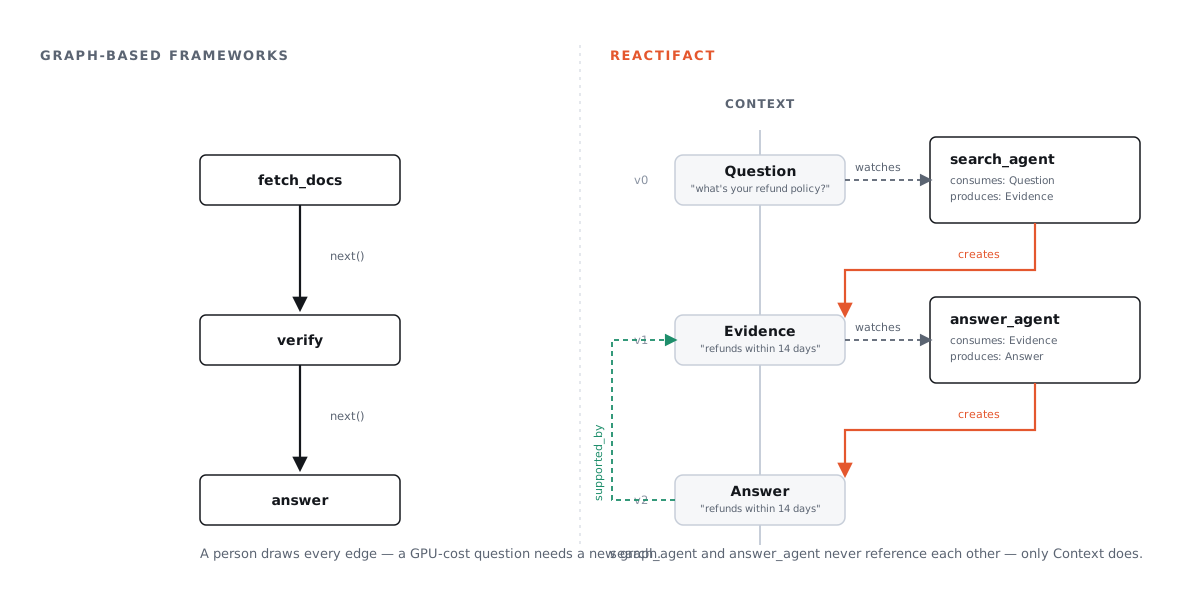
A LangGraph graph is the orchestration: you write add_edge, add_conditional_edges,
you decide by hand which node can follow which. That's the right model when
there genuinely is one path. It stops being the right model once the paths
multiply — a real knowledge-agent question ("why did infra costs jump in Q2?")
might need Confluence and GitLab and a CSV calculation and human
confirmation, and the next question needs a different subset. Encoding every
combination as graph edges turns into a combinatorial wiring exercise.
reactifact agents declare consumes/produces — what artifact types they react
to and what they can create. The runtime derives execution from which
artifacts actually exist, not from a pre-declared path. Two agents that have
never heard of each other compose correctly as long as one produces what the
other consumes. This is also why there's no viz.blueprint() node-and-edge
picture to keep in sync by hand — see Why reactifact for the
full argument.
3. Provenance: bolt-on vs. built-in
"Why did the agent answer this?" in LangGraph/CrewAI usually means reading logs, message history, or a custom trace you added yourself. There's no first-class notion of "this Answer artifact is derived from this Evidence, which was extracted from this Doc."
In reactifact, effects.create(...).link("supported_by", evidence) is a normal
part of writing a produce, and the resulting graph is queryable:
context.related(answer.id, "supported_by"), or rendered as a Mermaid graph
via context_to_mermaid(). This isn't a logging add-on — it's the same
mechanism the runtime uses to decide what to re-run after a rollback.
4. Determinism: the model computes vs. the model reasons
Ask an LLM to compute sum(gpu_cost) / sum(total_cost) inline in a chat
completion and it will confidently produce a number that is sometimes wrong —
this is not a prompting problem, it's what generative token-by-token math
does. Both LangGraph and CrewAI leave this entirely up to you (write a tool,
remember to call it, remember to trust its output over the model's).
reactifact's design bias — not a hard rule — is that a Produce doing arithmetic
over structured data (a CSV, a query result) should compute it in plain Python
and hand the LLM the result to explain, not the raw numbers to guess from.
The knowledge example does exactly this: the LLM writes the
prose, calc.py does the arithmetic.
5. Rollback and branching: checkpointer vs. git-like context
LangGraph has checkpointers for persistence and time-travel through
checkpoint history. reactifact's Context is versioned more literally: you can
context.branch() to fork a parallel exploration, run different agents on
each fork, and three-way merge() them back — see
Branching and the forklab example, which runs two
strategies on their own forks and merges the result.
If you're evaluating both
A reasonable trial: take one agent from your LangGraph/CrewAI project that does non-trivial branching (not a fixed 3-step pipeline) and port just that one to reactifact. If the artifact model and reactive dispatch make that agent's logic shorter and more honest about failure (no silent wrong-number hallucination, real "why" for its answer), the rest of the system is probably worth porting too. If it mostly adds ceremony for a genuinely linear flow, that agent was never the graph-heavy case reactifact is built for.
Starting from scratch (nothing to port)
The trial above assumes an existing graph to compare against. If you don't have one, the equivalent test doesn't need a pre-existing project — it needs a third thing to wire in after the fact:
- Pick a question that genuinely needs two independent things combined (a CSV number and a doc lookup, say — not a fixed A→B pipeline).
- Write it as two
Produces that each declare only what theyconsume/produce— the front-page example's two-agent snippet (find_evidence/answer) is the shape. Neither should import or reference the other by name. - Now add a third agent for a follow-up question that needs a different subset of the same data — without touching the first two agents' code.
If step 3 composes cleanly, that's the actual claim on this page, not a marketing line — open a discussion with what you built (or where it didn't compose the way this page claims); that's a faster way to get a straight answer than reading more docs, and it's exactly the kind of report that makes this comparison more honest over time.