reactifact
Event-driven agents for Python developers — tasks wake on typed artifacts, like Celery tasks wake on messages. No graph to draw.
Python developers already know this model from Celery: define a task,
declare what triggers it, let the runtime run it. reactifact applies it to agents — a task
reacts to a typed, versioned artifact appearing in the context, not to a
queue message you push or a graph edge you draw. The runtime derives what runs
next from state.
| Celery | reactifact |
|---|---|
| a task | @produce(Model) — a unit of work that writes an artifact |
delay() / apply_async() |
you don't call it: creating the input artifact is the trigger |
| routing key / queue | Consume(Type) — which artifact type wakes the task |
| chain / group / chord | several consumes / produces; the runtime derives the order |
retries, acks_late |
guards + Budget, an honest None instead of a wrong result |
| result backend | the Context — typed, versioned artifacts |
| worker | Runtime |
Single process today (no broker, no worker pool) — the model is Celery-shaped, not its distributed runtime.
On top of that model you get something a task queue doesn't: every artifact is
versioned with provenance, so a run is reproducible (context_hash) and
auditable (audit.report) for free. The model reasons; the deterministic parts
stay in code; every claim carries provenance.
On top: a provable answer
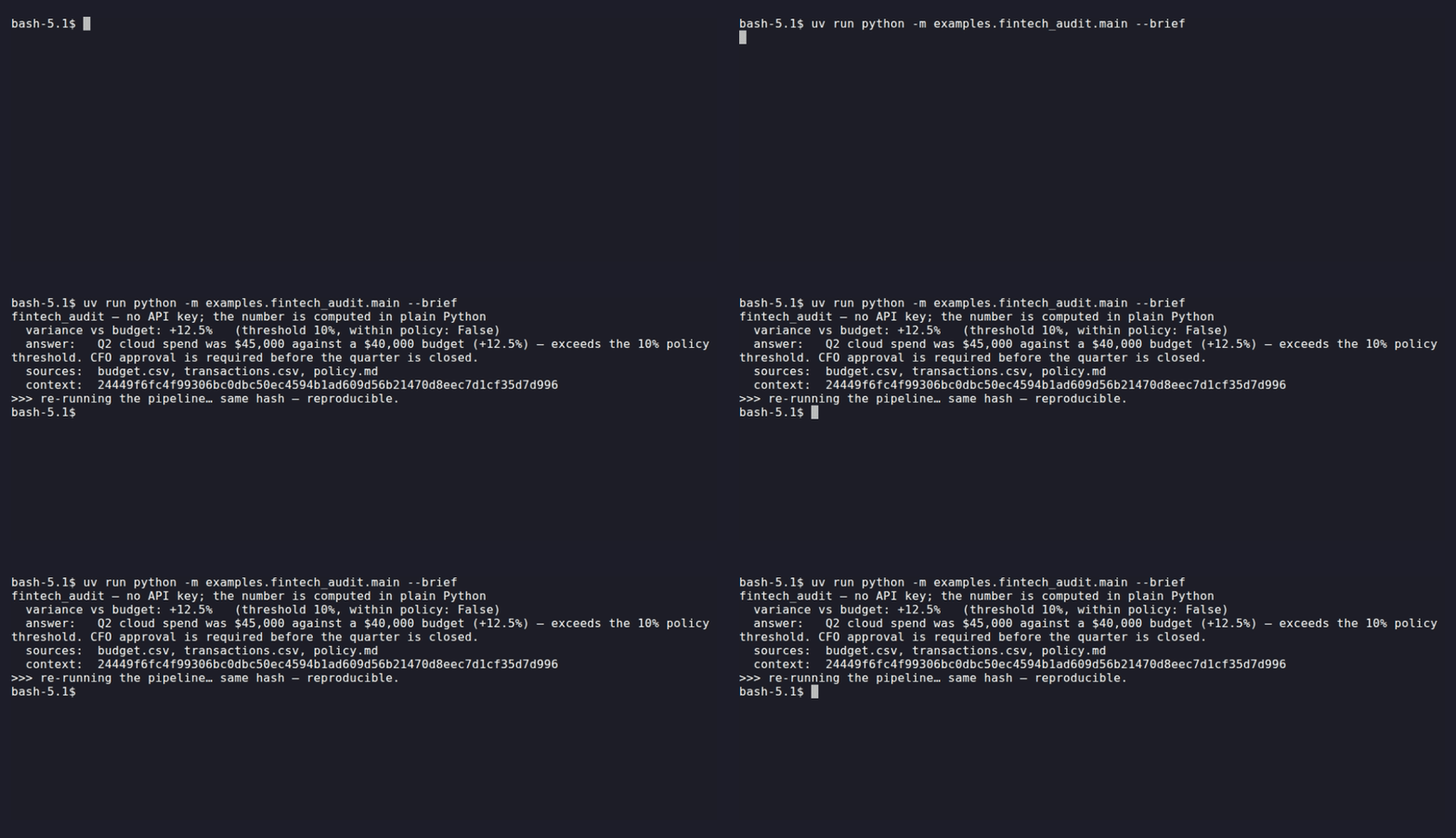
examples/fintech_audit — a transactions CSV, a
budget CSV and a policy doc, no API key. The model never computes the number;
plain Python does, and the answer is linked to its evidence:
variance vs budget: +12.5%   ($45,000 actual vs $40,000 budget, 10% policy threshold → over)
answer sha256 5461290d…  ·  context sha256 24449f6f…

re-running the pipeline hashes identically — or verify a saved run:
  reactifact replay <store> --session <id> --verify 24449f6f…
How it works
                                   EVENT (created/updated)
                                          │
                                          ▼
CONTEXT ───────► ARTIFACTS ──► AGENTS REACT ──self.effects──► EFFECTS
   ▲                 │                                            │
   │                 │                                            │  compile
   └────── CONTEXT' ◄────────────────┘ PATCH ◄────────────────────┘
You describe what data exists, what artifacts exist, and what agents can do with them. The runtime does the plumbing.
The mental model
| Traditional agent | reactifact |
|---|---|
| A program follows a graph / plan | Agents react to state changes |
| Messages are strings | Typed artifacts (Claim, Evidence, Answer, …) |
| Orchestration is explicit | Orchestration falls out of the state |
| A unit of work returns a change | A produce writes effects (self.effects) — the runtime compiles them |
| Retries/rollback are manual | Context is versioned (git-like commits, diff, rollback) |
| "Who produced this?" is lost | Provenance links every derived artifact to its inputs |
Why effects instead of "return a change"?
At the heart of the loop is how a produce makes a change. Many frameworks ask a
unit of work to return its result, and some orchestrator applies it. reactifact
inverts authorship: a produce states what should change via self.effects
(create / update / link / ask) and returns None; the runtime compiles the
effect set into one atomic patch — the whole step lands (or none of it does).
async def produce(self, call: ProduceCall) -> None:
    evidence = self.effects.create(Evidence(...), id="evidence:q1")
    answer = self.effects.create(Answer(...), id="answer:q1")
    evidence.link("extracted_from", doc)
    answer.link("supported_by", evidence)
    self.effects.update(turn, status="answered")
    return None
Because handles are objects, not ids, one statement can reference the artifact
created by another — and because the runtime owns the compilation, you never
assemble a Patch by hand. Human-in-the-loop is just another effect
(effects.ask(...)). See Why reactifact for the full argument,
and The produce contract for details.
Why artifacts instead of messages?
Messages are opaque; artifacts are inspectable. An Evidence object knows its
text, its source, and its score. Because every artifact carries provenance, the
runtime can answer "why did the agent say that?" by walking the links
Answer —supported_by→ Claim —derived_from→ Evidence —extracted_from→ Doc.
Why versioned context?
Every run is a commit. That gives you:
- Diff — exactly what changed between two turns.
- Rollback — undo a bad step and re-run from a clean state.
- Deterministic replays — the same history reproduces the same result.
- Inspectability — a full, queryable history of everything that happened.
Requires
- Python 3.11–3.14 (
.venvis managed byuv; CI runs the full suite on all four). pydanticfor artifact models; FastAPI/uvicorn only for the web demos.
Quick start
Two agents, no graph edge declared between them — the second reacts because the first one's output exists, and the answer carries proof of where it came from:
from pydantic import BaseModel

from reactifact import Budget, Consume, Context, Runtime, RuntimeResources, create_agent, produce


class Question(BaseModel):
    text: str


class Evidence(BaseModel):
    text: str


class Answer(BaseModel):
    text: str


DOCS = {
    "refund": "Refunds are available within 14 days of purchase.",
    "pricing": "The Pro plan is $49/month, billed annually.",
}


@produce(Evidence)
async def find_evidence(call):
    question = next((a for a in call.inputs if isinstance(a.data, Question)), None)
    if question is None:
        return None
    hit = next((v for k, v in DOCS.items() if k in question.data.text.lower()), None)
    if hit is not None:
        call.effects.create(Evidence(text=hit))


@produce(Answer)
async def answer_from_evidence(call):
    evidence = next((a for a in call.inputs if isinstance(a.data, Evidence)), None)
    if evidence is None:
        return None
    call.effects.create(Answer(text=evidence.data.text)).link("supported_by", evidence)


search_agent = create_agent("search", consumes=[Consume(Question)], produces=[find_evidence])
answer_agent = create_agent("answer", consumes=[Consume(Evidence)], produces=[answer_from_evidence])

ctx = Context(resources=RuntimeResources())
runtime = Runtime(ctx, agents=[search_agent, answer_agent], budget=Budget(max_runs=10))

ctx.create(Question(text="what's your refund policy?"))
runtime.run()  # search_agent and answer_agent both react — nobody wired them together

answer = ctx.latest(Answer)
evidence = ctx.related(answer.id, "supported_by")[0]
print(answer.data.text)                     # "Refunds are available within 14 days of purchase."
print("supported_by:", evidence.data.text)  # provenance you can trace, not just a string in a log
That is the whole loop: create an artifact → agents react → a patch is applied → the context version advances. Everything else in this documentation builds on that loop.
Ready for something closer to a real app? Quickstart has three runnable, verified snippets — a tool-calling agent, retrieval over your own docs, a session-persisted chat bot — each pointing at the full example it's trimmed from.
Where to go next
Understand the idea
- Why reactifact — the design argument: why effects, why no graph, why determinism, why versioned state.
- Comparison — reactifact vs LangGraph/CrewAI, feature by feature, and when not to use reactifact.
- Concepts — Context, Artifact, Patch, Agent, Produce.
Build with it
- Quickstart — three runnable snippets: tool-calling agent, retrieval over your docs, session-persisted chat bot.
- Sources — where agents get information from.
- Providers — wiring an LLM/embedder/image/speech provider
into
RuntimeResources. - Recipes — ready-made search fan-out, ref materialization, lifecycle state machines.
- Patterns — reusable shapes (reflection, map-reduce, supervisor, …), each backed by a concrete example.
Operate it
- Observability — every run traces agent spans, reads/writes, LLM calls; offline dashboard, or ship to Langfuse/Postgres.
- Troubleshooting — "my agent didn't run" / "ran twice" / "the run stopped early" — organized by symptom, not by feature.
- Evaluation — multi-level scoring over the final
Context(evidence quality, provenance grounding, calculation correctness, …). - Branching & merge — fork state, explore alternatives, three-way merge with explicit conflicts.
- Replay — reconstruct why the agent answered, deterministically, without re-running agents.
- Visualization & CLI — Mermaid diagrams of the artifact graph and
a run's trace; the
reactifactcommand-line tools. - API reference — every top-level symbol, one line each.
See it run
- Examples — fourteen working applications you can run.
- Port matrix — which classic LangGraph/CrewAI/DSPy pattern maps to which example.
- Design notes — deeper rationale for the adaptive scheduler and the effects → Patch compilation model.